Santal Organic Massage is a small, working wellness clinic my wife and I opened together. This is the long version of how it came to exist — the category read, the site search, the lease, the fit-out, the brand, the booking and payments stack, the opening, and the operating rhythm we've settled into since. A reminder that the disciplines of product — research, prototyping, thin slices, measurement — transfer completely to physical retail, with one important twist: the room itself is the product.
The read that started Santal was a simple one. If you stood in most Melbourne suburbs in 2024 and asked where someone should get a 60-minute massage, the answers clustered at two extremes. At the low end: high-volume shopfronts — fluorescent lights, shared rooms separated by curtains, ~$60 for an hour, often overworked therapists on short rosters. At the high end: day spas inside hotels and larger venues — $200+, full ritual, often more than a client needed for a weekly or fortnightly visit.
The middle was surprisingly thin: quiet, well-designed, calm rooms with experienced therapists, at a price a regular client could actually sustain. Not luxury, not cheap — considered. The brief that emerged was specific: a small number of private rooms, natural materials and soft light, a booking experience as clean as any digital product, and pricing that rewarded repeat visits without feeling transactional.
The instinct to apply product thinking to a physical service felt natural after Petzyo and PreCredits — but the honest reason to do it is that most service businesses don't. The benchmark is low. A considered booking flow, a clear set of offerings, and a room that feels the way the brand promises are three meaningful differentiators before anyone has paid a dollar.
Santal is a shared venture. My wife and I had talked about running something together for a long time, and the shape of this business suited the two sides of it. She brought the category instinct — what the room should feel like, how a client should be greeted, what a good massage actually is. I brought the operating scaffold — site, lease, brand, site, booking stack, payments, reporting, and the slower disciplines of running a small business with accounts, compliance and insurance.
Working with a spouse is a particular kind of arrangement — it has to be, because there isn't a way to leave the conversation at the office. What made it workable for us was the same thing that makes any good operating partnership work: clean division of responsibility, explicit decision rights, and a habit of talking about the business separately from talking about life. Most of the retrospective lessons in Chapter 08 are really about that — and they didn't come for free.
The numbers we used to pressure-test the concept weren't exotic. For a boutique format at three rooms, the question is always the same: what utilisation do you need, at what average ticket, to make the rent + labour + consumables equation work? Reasonable inputs, a conservative opening month, and a realistic ramp curve over the first year. The model fit comfortably inside a single spreadsheet.
The ratio that mattered most wasn't revenue — it was repeat rate. A new client acquired via search or a Google Business Profile is expensive; the same client rebooking on the way out of a first appointment is nearly free. The concept was designed around that rebooking moment from the start: the room had to earn it, and the booking flow had to make it effortless.
Before any fit-out, brand, or booking system, the shopfront is the one decision that shapes every other decision — and the one you cannot iterate on cheaply. A bad site with a good fit-out is still a bad site. A good site with a modest fit-out is a business.
The criteria we worked against were boring on purpose:
Residential density within a short walk or drive, enough weekday foot traffic to support discovery, street parking or paid parking nearby. Weekend feet are nice; it's weekday 5–7pm that pays the rent.
Enough internal depth to fit three treatment rooms + reception + small back-of-house without the rooms feeling like corridors. Ceiling height mattered as much as floor area — paper-lantern pendants and calm light don't work in a low box.
Existing hot water, basin access, and split-system HVAC were worth real money. Adding them from scratch is where fit-outs go over budget.
Term long enough to justify fit-out depreciation (we wanted at least a 3+3 or 5+5), fixed outgoings where possible, and a rent-free period covering the fit-out weeks.
The lease was the first negotiation where the fit-out conversation and the rent conversation had to be treated as one instrument. A lower nominal rent with no fit-out contribution is almost always worse than a slightly higher rent with a meaningful landlord contribution and a proper rent-free incentive — because the landlord is capitalising an improvement to their asset while you amortise it across the term.
We modelled three scenarios — base, stretch, and walk-away — with the monthly P&L impact of each. That gave us a defensible position on every specific clause: rent review mechanism, demolition clause, make-good at end of term, assignment and sublet rights, and the one most landlords push back on hardest: the bank guarantee. Walking into the negotiation with numbers instead of preferences changed the tone of the conversation entirely.
Read the Retail Leases Act for your state before you sign anything. The disclosure statement, minimum term, and make-good obligations are governed by law in Victoria — and a lot of standard landlord drafts quietly contradict the Act. A lease lawyer for a few hours is the cheapest insurance you will ever buy.
The interior was designed around one rule: the room has to do its job before the therapist does theirs. A client who walks in stressed should begin to downshift before anything is said. Sound, temperature, light colour, materials, and the small choreography of greeting — all of it belongs to the product.
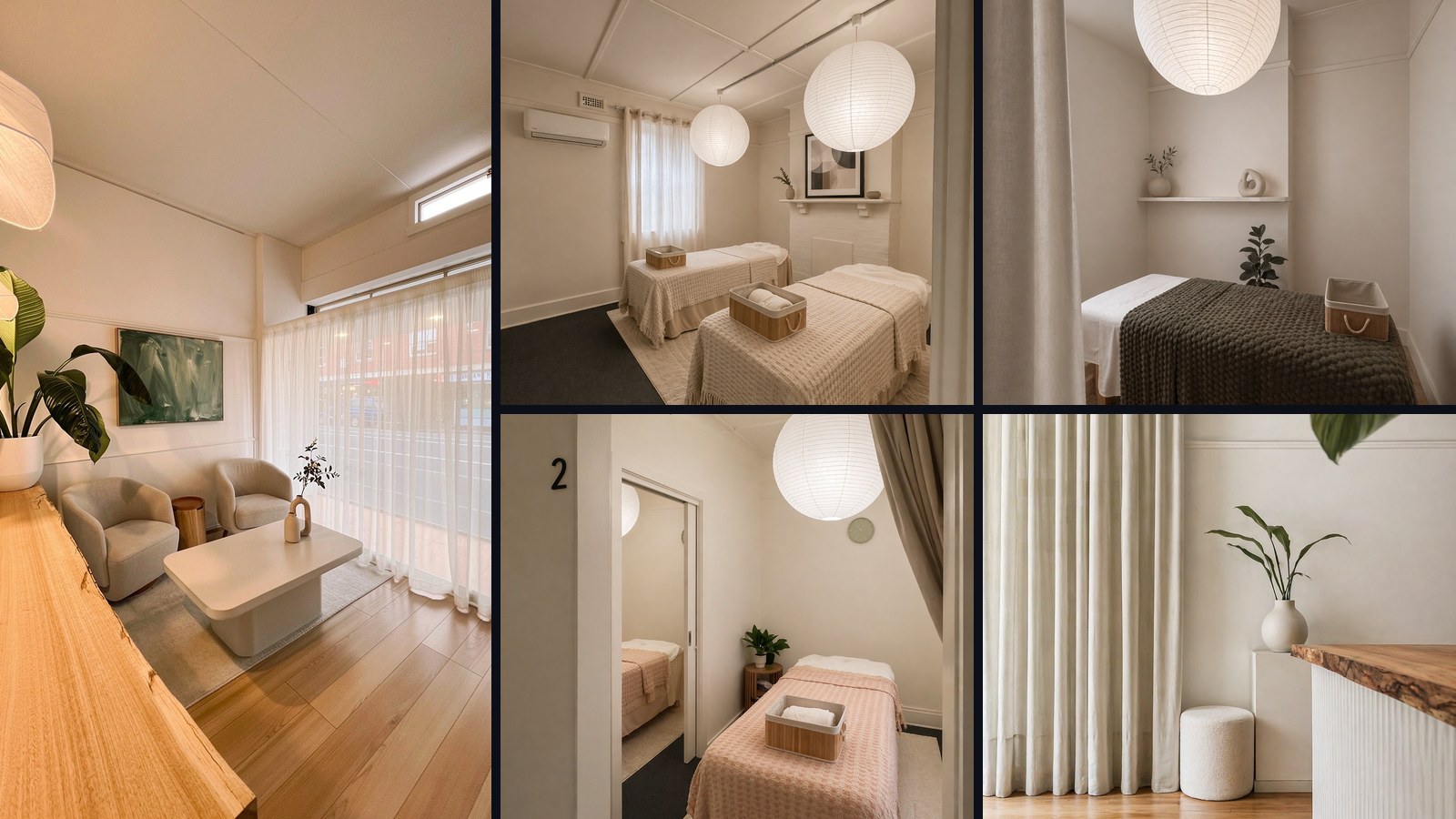
The palette is intentionally restrained. Warm whites, natural timber floors, cream linens and sheer curtains, paper-lantern pendants for diffuse light, a handful of plants, and a live-edge timber reception counter that sets the material tone the moment a client walks through the door. No branded wall graphics, no back-lit menus, no screens facing the client. The brand is in the room, not on the room.
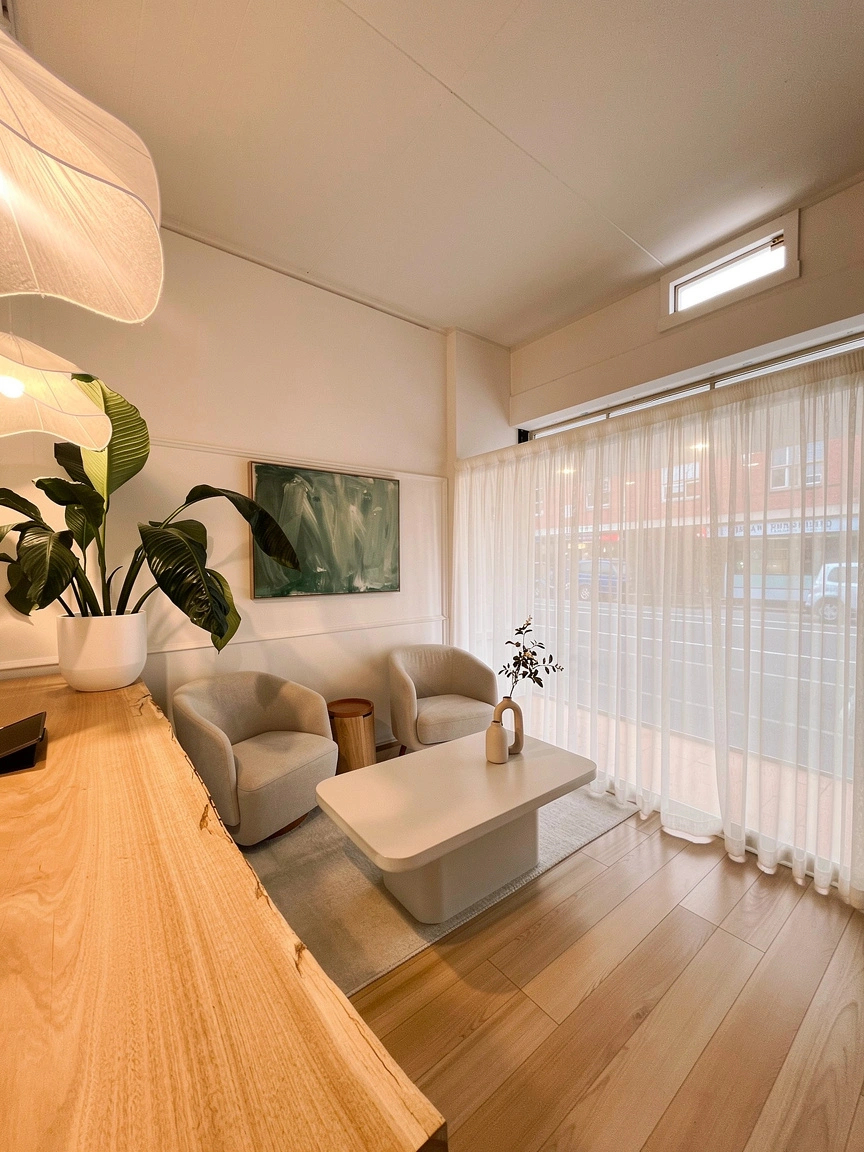 01 · Reception
Cream boucle seating, sheer curtains, live-edge counter. The brand is in the materials.
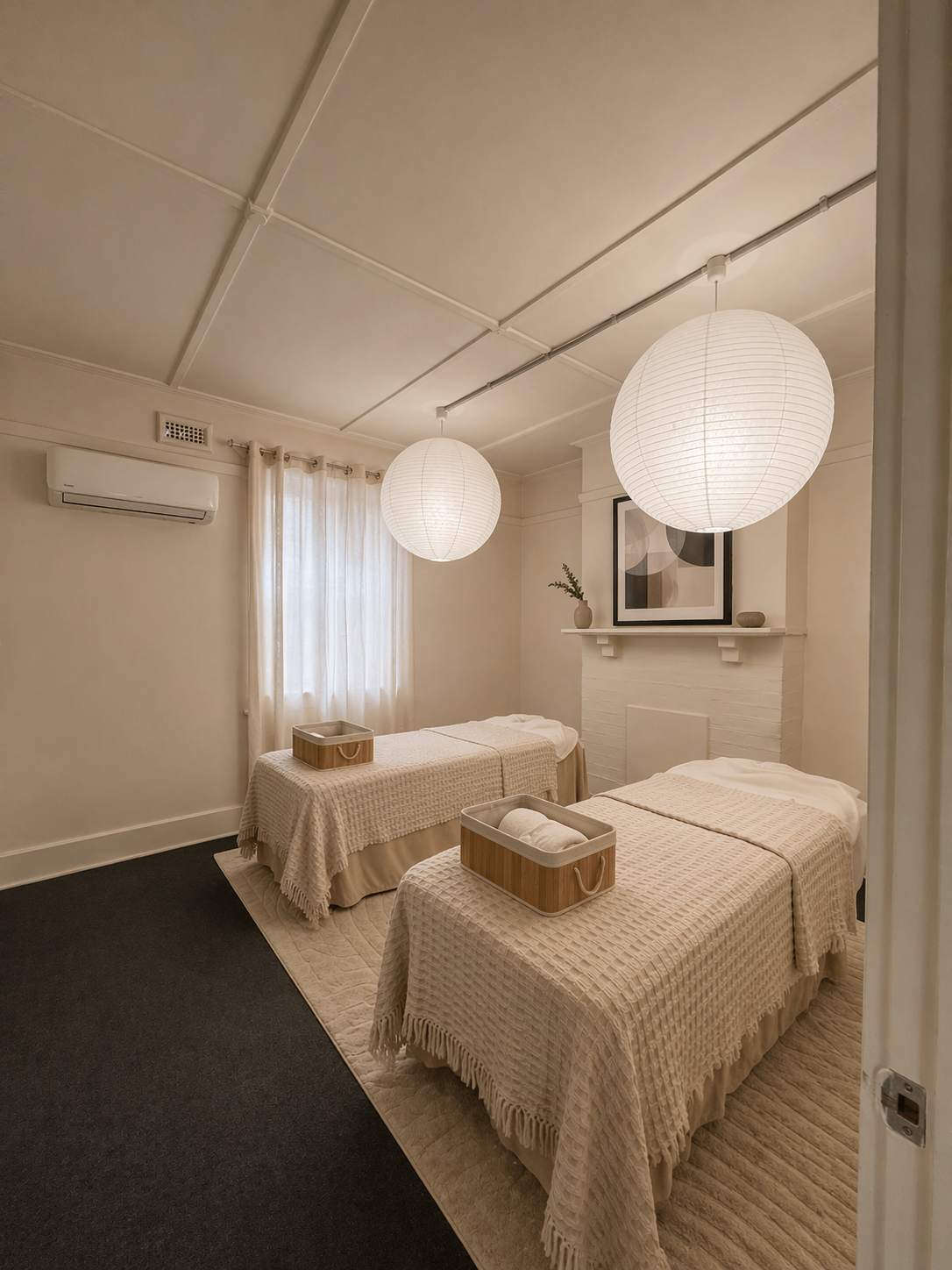 02 · Double room
Two-bed room for couples or friends. Paper-lantern pendants, matched linens, one framed landscape.
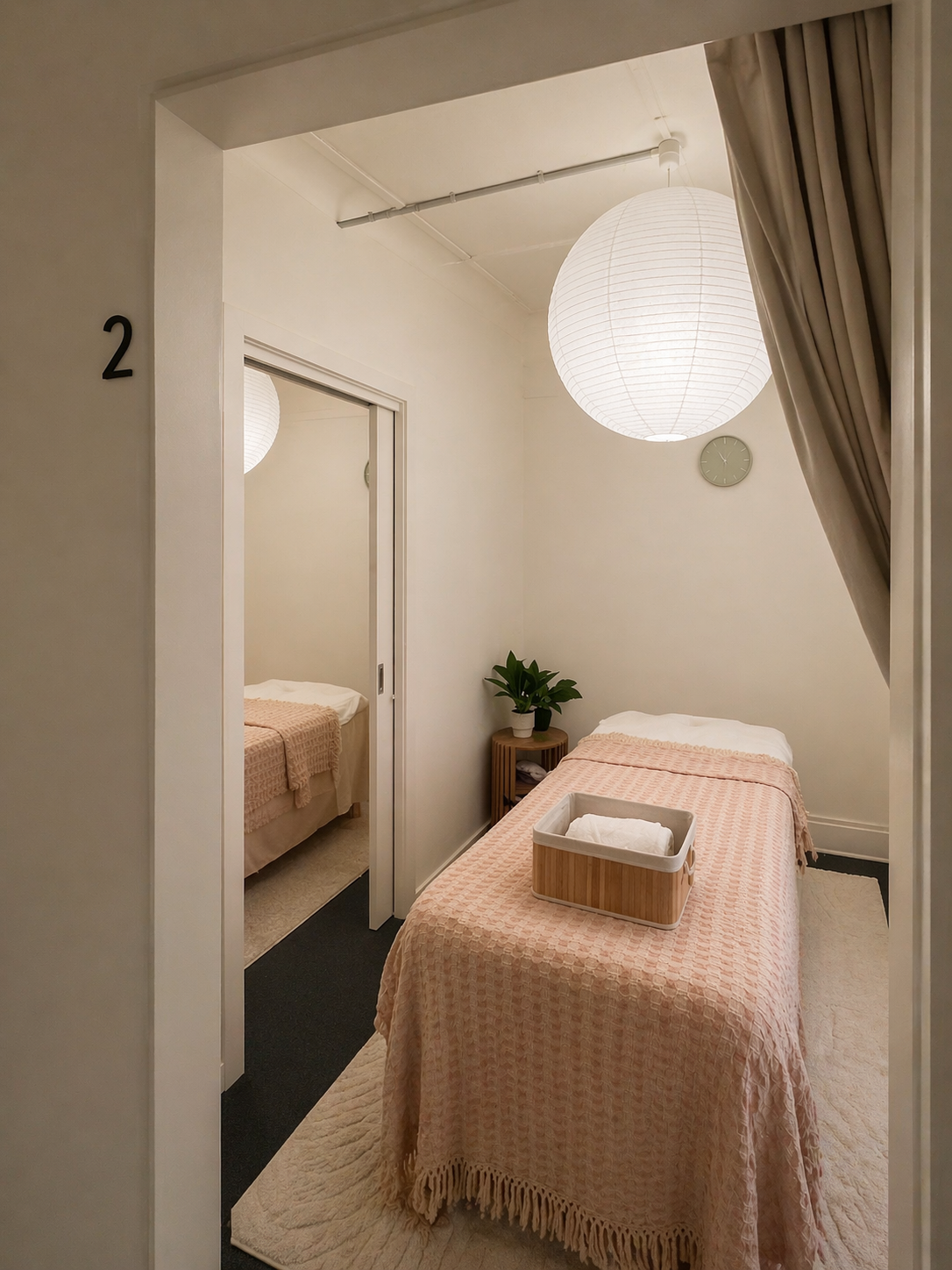 03 · Single — room 2
Soft blush throw, single pendant, a glimpse through to the adjoining single room.
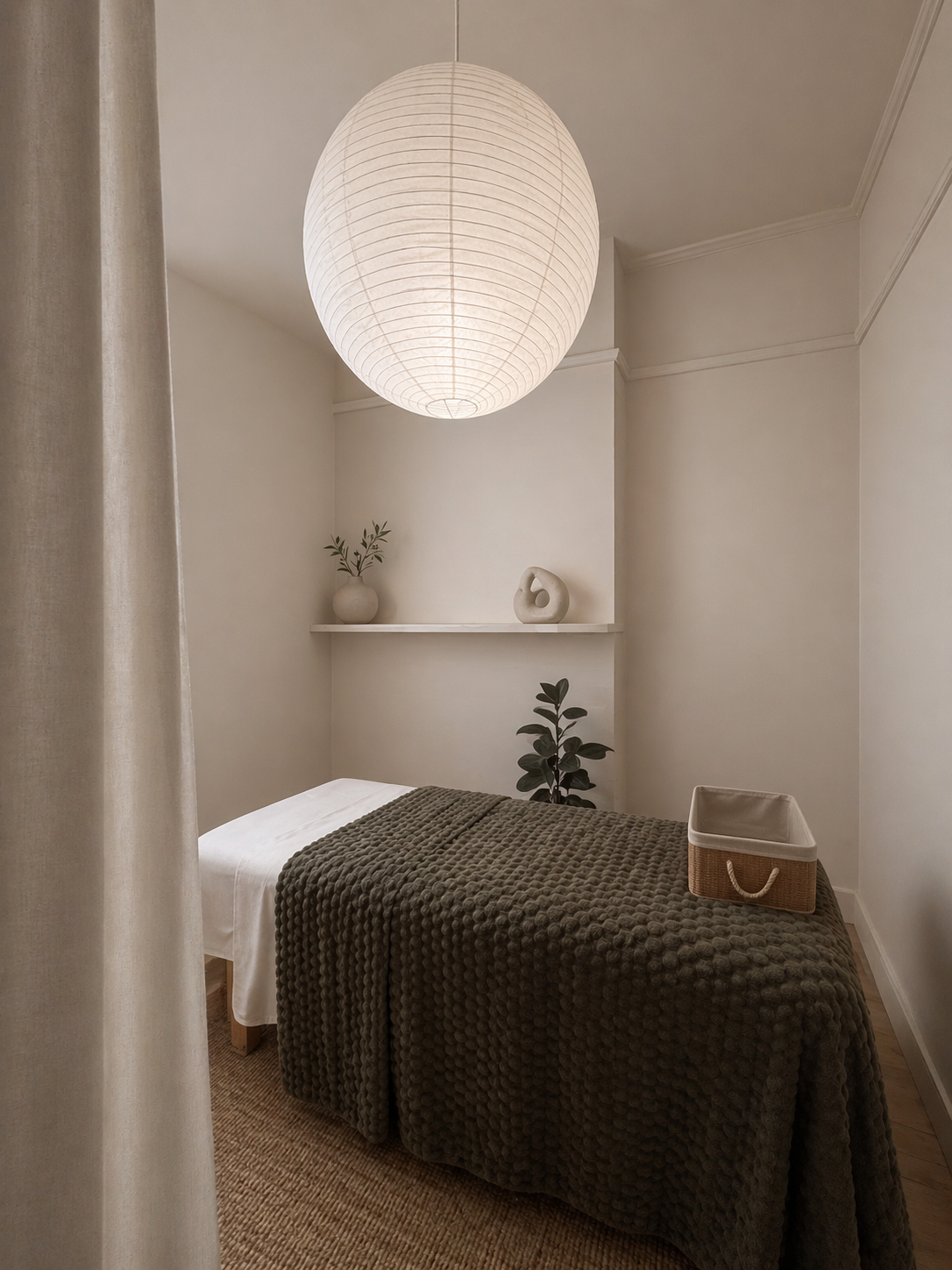 04 · Single — room 3
Olive textured throw, hanging paper lantern, small wall shelf with plants and a ceramic object.
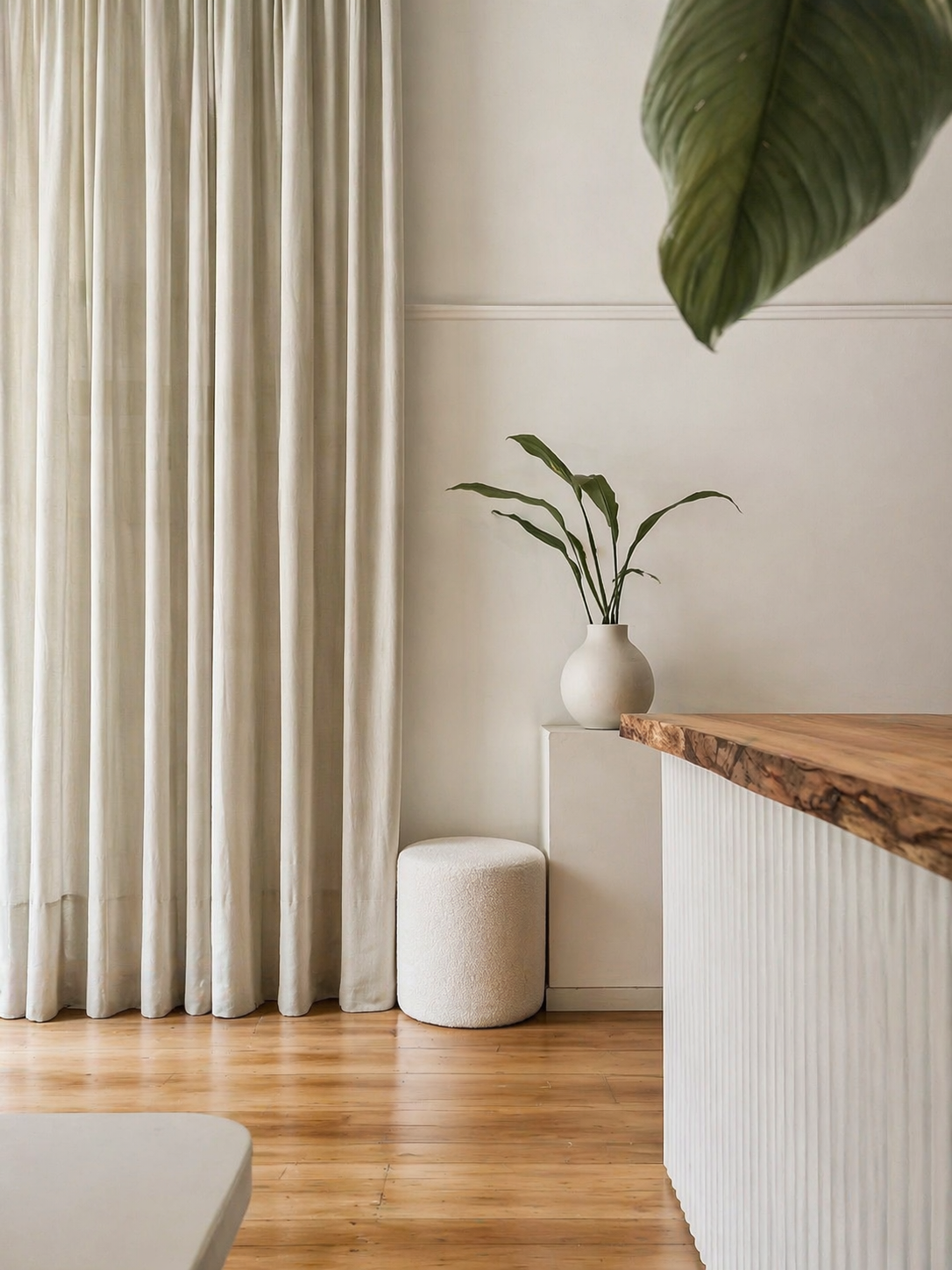 05 · Counter detail
Live-edge counter edge, linen sheer, boucle ottoman, ceramic vase with a single stem.
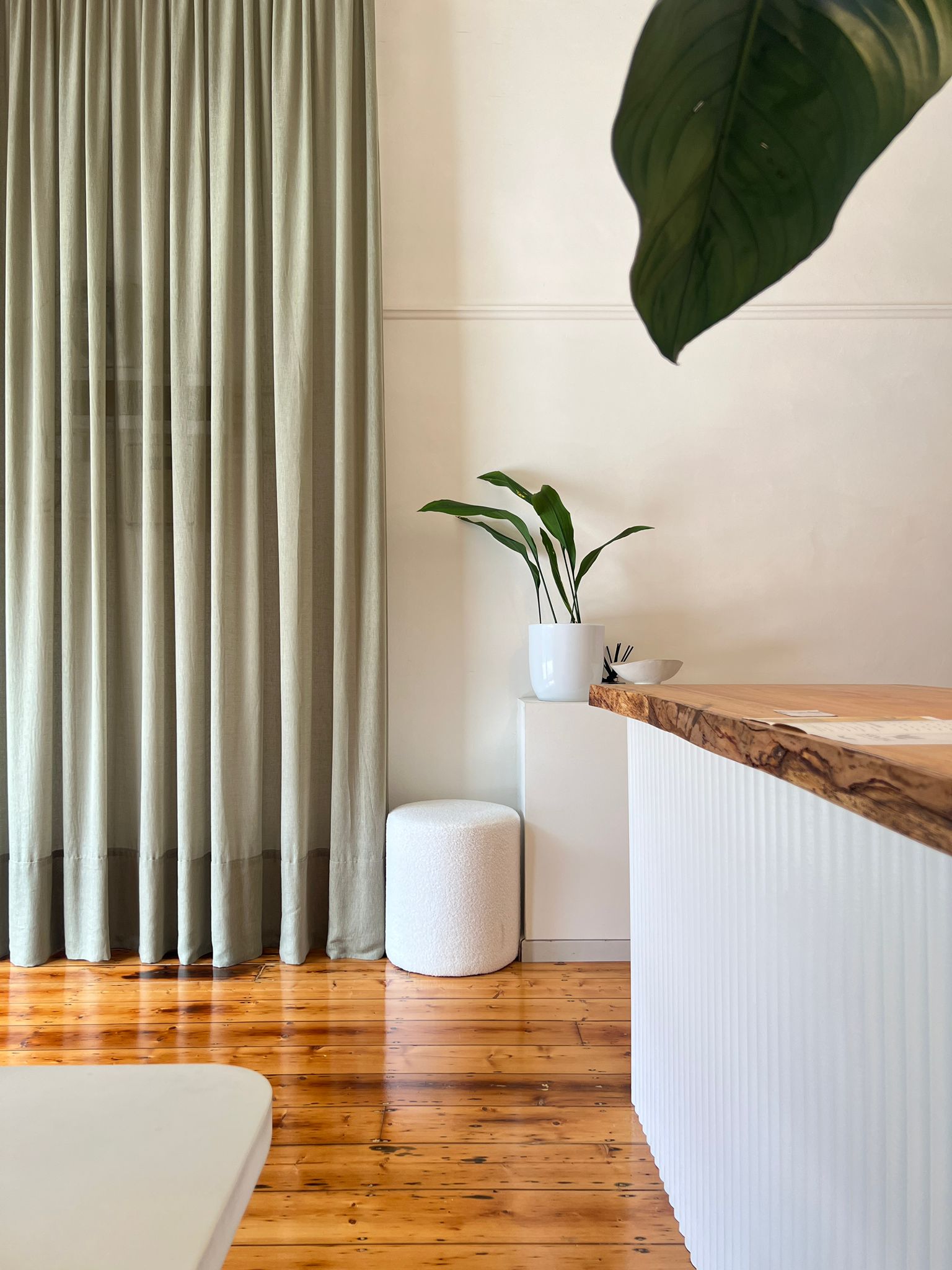 06 · Earlier styling
An earlier pass with sage-green linen curtains — same room, different tone. Iteration on a physical product is slower and more expensive, which is exactly why it has to be deliberate.
The principle throughout the fit-out was the same principle I've used on every digital product: spend where the customer experiences the spend directly, save where they don't. Linens, lighting, mattresses, sound insulation, and the reception counter were where the budget went. Joinery in back-of-house, signage hardware, and office fit-out were where we went plain.
The one item I would upgrade in hindsight is the acoustic treatment between rooms. It was better than code and better than most shopfronts we'd visited — and it still wasn't enough in the quiet moments. The next iteration will have proper acoustic baffling in ceiling cavities, not just wall insulation. It's a solvable problem; it just has to be solved before the client notices.
The brand brief was almost reductive: calm, warm, credible, easy to book. Not ornate, not aspirational in a way that requires a gallery to prop it up. The name — Santal Organic — carries the note we wanted: santal (sandalwood) for warmth and grounding, organic for the ingredient posture across the treatments we chose to lean into.
The identity is a simple serif wordmark, a restrained colour palette of warm whites and soft accents, and type choices that carry into the site, the booking confirmations, and the printed menus in each room. The visual system was designed so that it could be executed by anyone — signage fabricator, printer, web developer — without losing its temperature.
A boutique brand should feel quieter in its marketing than it does in its room. Overclaim online, underdeliver physically, and the client's first impression is the dissonance. Underclaim online, overdeliver physically, and the client becomes the marketing.
The website was built as a thin slice — a small number of pages, each one written to do one job. A clear list of services with honest pricing, a booking flow that opens directly into the platform calendar, a short "about" page that explains the room rather than the founders, and a contact panel with actual humans to talk to. Nothing more until the data tells us otherwise.
I've watched too many service businesses ship 30-page websites with animated hero sections and empty blog archives. The rebuilds are always in the same direction: less. We skipped that round entirely. Ship small, measure, add only what the client actually asked for.
One of the clearest advantages of starting a physical business in 2025 is the operating stack. Ten years ago, a three-room clinic would have needed bespoke booking software, a standalone EFTPOS terminal, a separate gift-card system, a newsletter tool that didn't talk to any of them, and a spreadsheet stitched together by hand to reconcile the whole thing. In 2025 you pick three or four tools and wire them together in an afternoon.
The principle was the same as every digital product I've shipped: rent best-in-class infrastructure, own the data access and the customer relationship. No custom builds where an off-the-shelf tool would do the job. Custom work reserved for the bits that shape the experience — booking flow copy, confirmation emails, the post-visit rebook nudge.
Online calendar, therapist rostering, service library, gift-card issuance, client history. Chosen for reliability and a clean client-facing flow, not for the longest feature list.
One merchant account, one reconciliation, same experience online and in-room. Reduces the surface area for errors at the counter.
Automated booking confirmations and 24-hour reminders to reduce no-shows. Post-visit rebook nudge is the single highest-ROI piece of comms.
A small, fast site. Booking opens the platform in a new tab instead of trying to simulate it on page. Fewer moving parts, fewer breakages.
Bank feed, automatic BAS, receipts captured to the right cost category at source. No shoeboxes. No quarter-end catch-up.
Utilisation, rebook rate, new vs. returning, average ticket, refunds. One page, same format each week. The same operating habit I use for AI products.
The test I apply to every tool is the same: can I export the data if the vendor disappears tomorrow? If the answer is no, the tool isn't the stack — it's a hostage situation. Everything we've chosen passes that test.
The opening was structured the way I would structure a product launch: closed beta, open beta, general availability. A friends-and-family week to pressure-test every part of the experience — the booking flow, the greeting, the room changeover, the post-visit follow-up — with people who would tell us the truth. Then a quiet open to the public while we tightened operations. Then the wider announcement.
The things that needed fixing in that first fortnight weren't the things the business plan worried about. They were small, specific, and only visible once a real client walked the space: the angle of the side lamp in room 2, the volume of the bell on the arrival chime, the order of confirmation text in the SMS, the exact phrasing of the rebook prompt at the counter. Every one of them got logged and fixed inside a week. That cadence matters.
Linen change, room reset, restock of consumables, final sweep. A written checklist in each room — not a vibe. Consistency is what a client is paying for.
Utilisation by day and by therapist, rebook rate, new vs. returning, average ticket, refunds, any client feedback. Same format each week so trend is readable at a glance.
Reconciled accounts, variance vs. plan, a short note on what the month told us that the plan didn't know. This is the meeting where the next thirty days actually get decided.
Do the services still reflect what clients actually book? Is pricing fair on both sides — enough margin to pay therapists properly, not so much the regulars quietly drop off? Adjust, don't drift.
In a physical services business the headline numbers people ask about — total revenue, foot traffic — are the least useful ones. The three ratios that run the business are room utilisation, rebook rate, and new-vs-returning mix. A clinic with 70% utilisation and a 60% rebook rate is a business. A clinic with the same revenue composed mostly of one-time bookings from paid acquisition is a treadmill.
This block is where the real trading numbers go once the twelve-month view is meaningful to publish. Until then, the ratios above are targets the business was designed around — not claims about achieved performance.
Paid search and social have their place in a launch — they fill the calendar while organic word-of-mouth builds. But the lesson we've seen repeat across small wellness businesses is simple: the cheapest new client is the existing client's friend. A referral card at the counter, a gift-voucher offering, and an experience worth talking about will outperform a paid acquisition channel inside the first six months if the room earns it.
That's the reason the rebook prompt — the specific thirty-second conversation at the end of a treatment — was designed as carefully as the booking page. It is the single highest-leverage interaction in the business.
The headline insight from standing Santal up is not that physical retail is like digital product, or that it isn't. It's that the disciplines are identical and the feedback loops are different. In software, a change ships in minutes and data arrives the same day. In a clinic, a change takes a week and a client survey is a month of signal. The rigour has to compensate for the latency.
Some of these are familiar from the Petzyo and PreCredits chapters. A few are specific to running a venue with a partner you come home with.
Every downstream decision — fit-out cost, therapist rostering, weekday vs. weekend mix, paid-acquisition cost — is shaped by the site you sign. Model three scenarios before you agree to heads of terms, not after.
Linens, lighting, acoustic treatment, the reception counter. Nobody remembers the office joinery in back-of-house. Everybody remembers how the room sounded when they lay down.
Rent best-in-class infrastructure; don't write custom software to run a three-room clinic. Own the data and the rebook conversation — the rest is plumbing.
Soft open with friends and family, fix the twenty small things only real clients will notice, then open quietly to the public. A launch party is not a launch strategy.
Clean division of responsibility, explicit decision rights, and a habit of ending the business conversation before the evening starts. The same governance rigour you'd use with any co-founder — and then some.