CASE STUDY · PETZYO · 2016 – 2019

How I built Australia's first D2C
personalised pet food company — solo.

From a half-formed idea at a kitchen table to a running subscription business, a forced exit on unfavourable terms, and a brand that's still trading today. This is the long version of the Petzyo story — the decisions, the prototypes, two business plans, the investment conversation, the hard exit, and what all of it taught me about building AI products now.

founded 2016
exited 2019
role Founder, Director, solo operator
category D2C · Subscription · Pet nutrition
The journey at a glance

From idea at a kitchen table to a hard exit — in 8 steps.

2015
The insight
Category gap identified. Unit-economics spreadsheet v1.
EARLY 2016
Prototyping
Landing page tests, manufacturer sampling, quiz v1.
MID 2016
Plan v1 & launch
First business plan, brand, Shopify storefront live.
LATE 2016
First subscribers
First paying customers. Reorder data starts flowing.
APR 2018
93 subscribers
Annualised forward revenue ~$65K. Baseline before the mar-tech push.
AUG 2018
240 subscribers
30%+ MoM for 4 straight months. Ad spend falling. ADD TO BOX launching.
2019
Exit
Exit under pressure on unfavourable terms. Excluded from operations and unable to fund legal options at the time. The brand continues to operate today.
2026
Still trading
petzyo.com.au continues to operate under new ownership.
Chapter 01 · The concept

A fragmented category, ready for a direct relationship.

In 2015 the Australian pet food market was a lopsided picture. On one side, supermarket brands competing ferociously on shelf space and price — sold by weight and volume, not by fit. On the other, premium brands locked behind vet clinics and specialty retailers, with the gatekeeping markup that comes with that distribution. Almost no one was speaking to pet owners directly, asking what their specific dog actually needed, and delivering the right amount to their door on a repeating schedule.

The insight that became Petzyo was simple: owners don't want bags of food, they want their dog fed well without thinking about it. That reframe changed everything — pricing, onboarding, packaging, repeat cadence, and how the brand spoke to customers. The big overseas D2C players (Ollie, The Farmer's Dog, Butternut Box) hadn't entered Australia. Subscription commerce infrastructure was finally mature. Cat and dog ownership was up. Everything pointed at the same opening.

Note

"Personalised pet food delivery" sounds obvious in hindsight. In 2016 it was still a pitch that had to be explained to nearly every investor, supplier, and friend — the idea that a dog might need a plan, not just a bag, was genuinely new to most Australians.

The personal spark

The market observation was one half of it. The other half was personal, and it came first. In 2016 I was working at the Victorian State Government — Department of Education, in what was, on paper, a stable and enviable role. Then a colleague I worked closely with was let go because of her mental health. Whatever the institution intended, what the moment communicated to everyone around it was: you are valuable here until you aren't. I remember walking out of the office that week thinking, very clearly, this is not the kind of life I want to build.

So I left — and instead of lining up another government role, I gave myself permission to spend the next stretch deep-searching for an idea worth betting on. No cofounder, no runway, no safety net beyond the decision that a rigid institution wasn't going to be where I spent my thirties.

The thing that kept pulling me back was Dollar Shave Club. In July 2016, Unilever had just acquired them for US$1 billion — a five-year-old company whose entire thesis was "men don't want to drive to Target to buy overpriced razors; give us a subscription and we'll send you decent ones." It was the cleanest proof yet that direct-to-consumer subscription, done right, could take a stale, retail-dominated category and re-draw it from scratch.

I spent the following weeks deep-searching the same question in different shapes: what other mass-consumed, category-captured, retail-fatigued product is sitting in Australia waiting for the same treatment? I ran through razors (taken), mattresses (taken — Koala), meal kits (taken — Marley Spoon), vitamins, coffee, contact lenses, bedding, wine. Pet food kept returning to the top of the list: 39% of Australian households owned a dog, the category was growing ~14% year-on-year, over 95% of spend still flowed through supermarkets and specialty retailers, and customers cared about their pets more intensely than almost any other category — yet were being sold to as if they were buying dishwasher tablets.

That was the opening. The institutional side of my life had pushed me out; Dollar Shave Club had given me the model; the Australian pet-food category sat there as the obvious place to apply it. Petzyo started from that intersection — part reaction against a work culture I didn't want to repeat, part deliberate search for the next D2C wave.

Naming & early brand exploration

Before Plan v1 was written, I spent a few weeks pressure-testing names and visual directions. The working name at the time was PetzYo Dining — I was trying to signal the "proper meal" framing as a deliberate contrast to the bag-of-kibble category norm. I commissioned a handful of logo concepts and lived with them for a while. Four of the concepts are below.
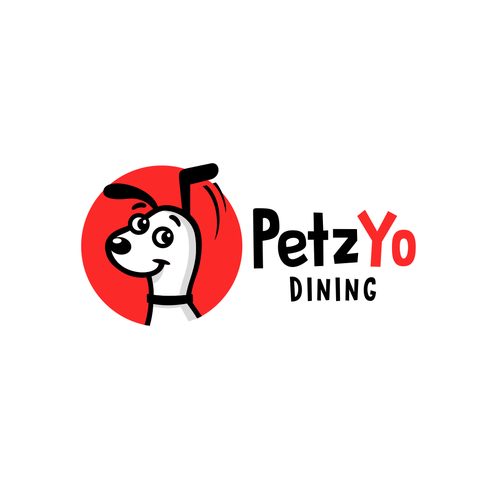
PetzYo Dining concept — red-circle dog head with wordmark 01 · Red-circle dog head

Warm and retro; the red circle later echoed into the final brand.
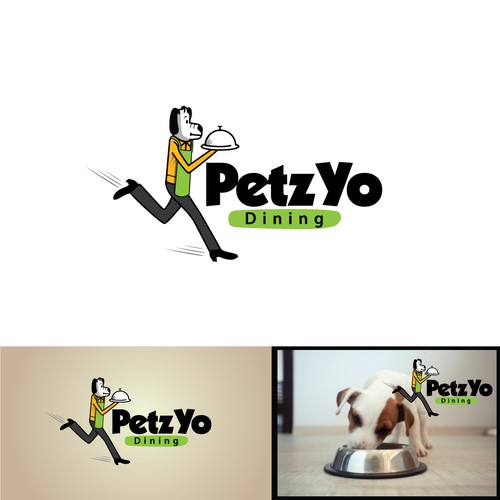
PetzYo Dining concept — running dog holding a food platter 02 · Running dog with platter

Literal delivery metaphor — locked the brand into one service identity.
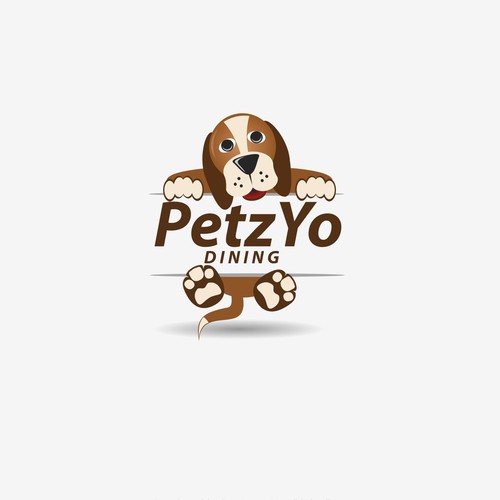
PetzYo Dining concept — beagle crest 03 · Beagle crest

Heraldic and premium, but too vet-clinic for a D2C disruptor.
PetzYo Dining concept — compact stacked red-circle mark 04 · Compact red-circle mark

Stacked variation of 01 for favicons, app icons and packaging stamps.

What I ended up shipping was different from all four. I dropped "Dining" — it was narrowing the category too early and confused people about what we actually sold. I kept the sound of the name (PETZYO, no space), simplified the wordmark to a single confident red brush-script, and let the product and packaging carry the personality rather than the mark doing all the work.

In hindsight the four concepts were useful as elimination, not selection. Seeing them side-by-side made it obvious which direction wasn't right, and that clarity made the brief to the designer who eventually delivered the shipped mark considerably sharper. The lesson I'd draw for any founder: explore widely on a throwaway name first, then commit narrowly on the one you'll actually register.
Chapter 02 · The first business plan

Plan v1: a 16-page Investor Memorandum, dated 7 December 2016.

Plan v1 isn't a reconstruction. It's an actual document — in fact it's two actual documents. There was a first draft written in early October 2016 as a NEIF funding application (18 pages, title page dated 3 October 2016), and then a second draft — the one I consider the canonical Plan v1 — written two months later as a full Investor Memorandum dated Wednesday, 7 December 2016. The second draft is the artefact I used to open conversations with prospective investors, mentors, and suppliers, and it's what anchored the business's first public identity. Both PDFs are attached below.

PETZYO
NEIF
APPLICATION
Attachment · First draft

Petzyo — NEIF Funding Application

PDF · 18 pages · 3 October 2016 · Written by Sam Keil · Earliest form of the plan
Open PDF →

The earliest written form of the plan — prepared as a funding application two months before the full IM. Included here for completeness; the document referenced throughout this chapter is the 7 December 2016 version below.

PETZYO
INVESTOR
MEMO
Attachment · Second draft · Canonical Plan v1

Petzyo Investor Memorandum

PDF · 16 pages · Wednesday, 7 December 2016 · Written by Sam Keil
Open PDF →

The numbers in this document are forward projections from December 2016 — not actual results. Reality diverged from them in all the usual ways; Chapter 07 shows how.

Inception
August 2016
Plan written
Dec 2016
Planned launch
Late Feb 2017
Team
Solo founder

Mission & positioning

The IM opened with a one-line mission that stayed remarkably stable across the entire lifecycle of the business: "to make excellent quality pet-care a simple process." Positioning was explicit about its reference class — Petzyo was pitched as the "HelloFresh of pet-food", using three 2016-era D2C subscription benchmarks as validation:

Comparable · Razors

Dollar Shave Club

Acquired by Unilever in July 2016 for US$1 billion, five years after launch. Proof that D2C subscription could take a category dominated by supermarket distribution and rewrite it.

Comparable · Pet toys

Bark & Co / BarkBox

200,000 monthly subscribers and a US$250M valuation in 2016 — proof that subscription worked specifically in the pet-owner demographic, not just human categories.

Comparable · Meal kits

HelloFresh

The operational template — personalised, repeating, cold-chain-adjacent. Petzyo was positioned as "the HelloFresh of pet-food" in almost every investor conversation.

Direct competitor

Dog Delivery Bag

A small Sydney-based subscription-box pet-food business — very high-end, no raw meat patties, no customisation. Named in the IM as the only direct AU competitor, and not considered a serious threat.

The market opportunity (as framed in Dec 2016)

The IM grounded the opportunity in six specific industry statistics. These were the numbers I repeated in every investor conversation for the next year:

$8B
Australian pet-care industry size
14%
Annual category growth (to 2021)
3,000%
Subscription-box growth, prior 3 years
39%
AU households owning a dog
48%
AU adults who'd take a first or additional pet
16%
Annualised growth, AU online pet-care sales

The IM also mapped the incumbent field explicitly: Mars, Nestlé and VIP Topco as the dominant manufacturers; GreenCross, Wesfarmers and Woolworths as the retail sellers; My Pet Warehouse, Pet Circle and Wesfarmers as the online marketplaces. All of them were operating on a traditional retail or marketplace model — none had a customer-centric subscription offering — which was the wedge.

What Plan v1 got right — and what it got wrong

Got right
  • The market wedge — retail-dominated category, no AU D2C subscription incumbent.
  • The three-SKU architecture (dry · hybrid · raw) was the right coverage of the category.
  • The "Mongrel's Mix" bridge SKU did indeed end up being the highest-volume plan.
  • Melbourne-first geographic focus held — it's what allowed unit economics to work at low volume.
  • The lean-stack direction was right, even though the specific tool choice shifted at launch — I went with Shopify + Bold Recurring Orders instead of the IM's planned SquareSpace + Shopify plugin, which turned out to be the correct path and let me launch without raising first.
Got wrong
  • 500% annual growth was aspirational, not operational — Year 1 was closer to build-phase than 400 plans.
  • The margin assumptions under-weighted logistics cost at low volume (cold-chain raw was particularly brutal).
  • The 10-tonne MOQ for dry food was the right product but wrong capital commitment for a solo founder.
  • The "HelloFresh of pet-food" framing set investor expectations of a fundraise we didn't go after.
  • CAC on social sat higher than the payback-in-2–3-orders assumption — the real shape of retention only came through from month 4 onward.
Plan v1's real function

In hindsight, Plan v1 wasn't a forecasting tool. It was a coordinating tool — a single artefact I could hand to a supplier, a mentor, an investor, a designer, and have them all speak about the same business. The numbers inside it mattered less than the fact that it existed, looked professional, and committed me publicly to a specific set of choices. Plan v2 (Chapter 05) is where I'd actually stop pitching and start steering.

Chapter 03 · Prototyping & early validation

Four research tracks, all running at once: market, competitors, packaging, production.

Petzyo was my third venture, not my first — and that mattered. Before it, I'd co-founded Wattson (an LGBT nightlife and events app launched in late 2013 that grew past 8,000 users and connected 5,000+ venues across an international demographic, backed in part by Facebook's FB Start & Accelerate program) and earlier founded NetworkingFitness (a global online directory launched in 2010 that eventually listed 7,000+ service providers across AU, US and UK). Neither had been easy; both had taught me where first-time founders waste money, time, and belief. So this time I came into it with a clear discipline: don't fall in love with the product before you've pressure-tested the market, the competitors, the packaging, and the production economics.

Before I wrote a business plan or signed a supplier, I ran four parallel research tracks — market, competitors, packaging, production — and tried to spend as little as possible on each until a clear signal emerged. The gallery below shows actual artefacts from that period.

Track 01 · Market research

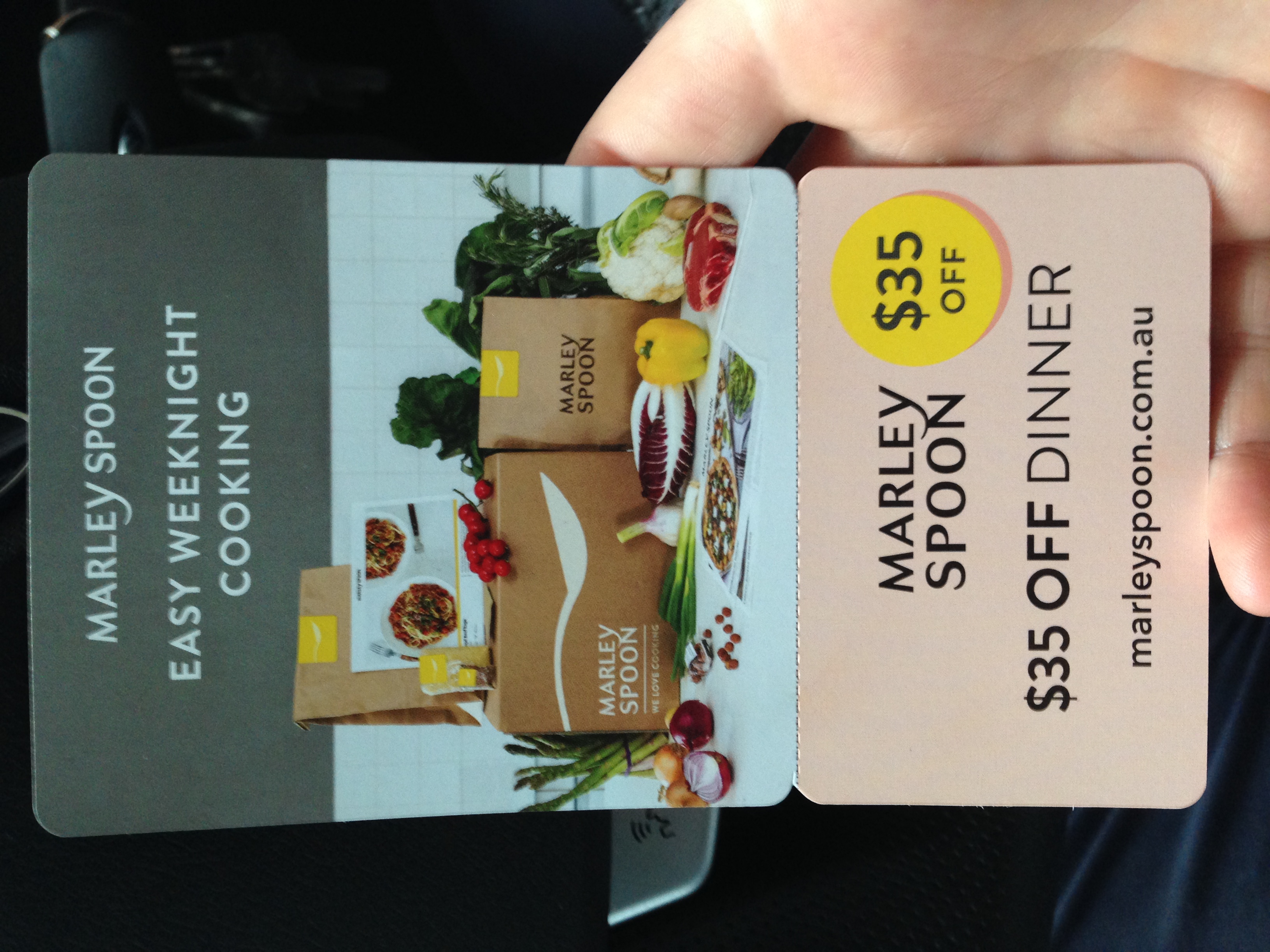
The personalised, direct-to-consumer pet-food category didn't exist in Australia yet. So I studied the adjacent categories that were working — particularly human-food D2C subscription brands like Marley Spoon. Their acquisition mechanics, offer structure (dollar-off rather than percentage-off, hand-addressed cards, timed first-order triggers), onboarding cadence, and retention playbook were all directly transferable. I collected their mailers, traced their funnel, and reverse-engineered their email flows. The point wasn't to copy them — it was to understand what Australians had already been trained to expect from a D2C subscription.

Track 02 · Competitor research

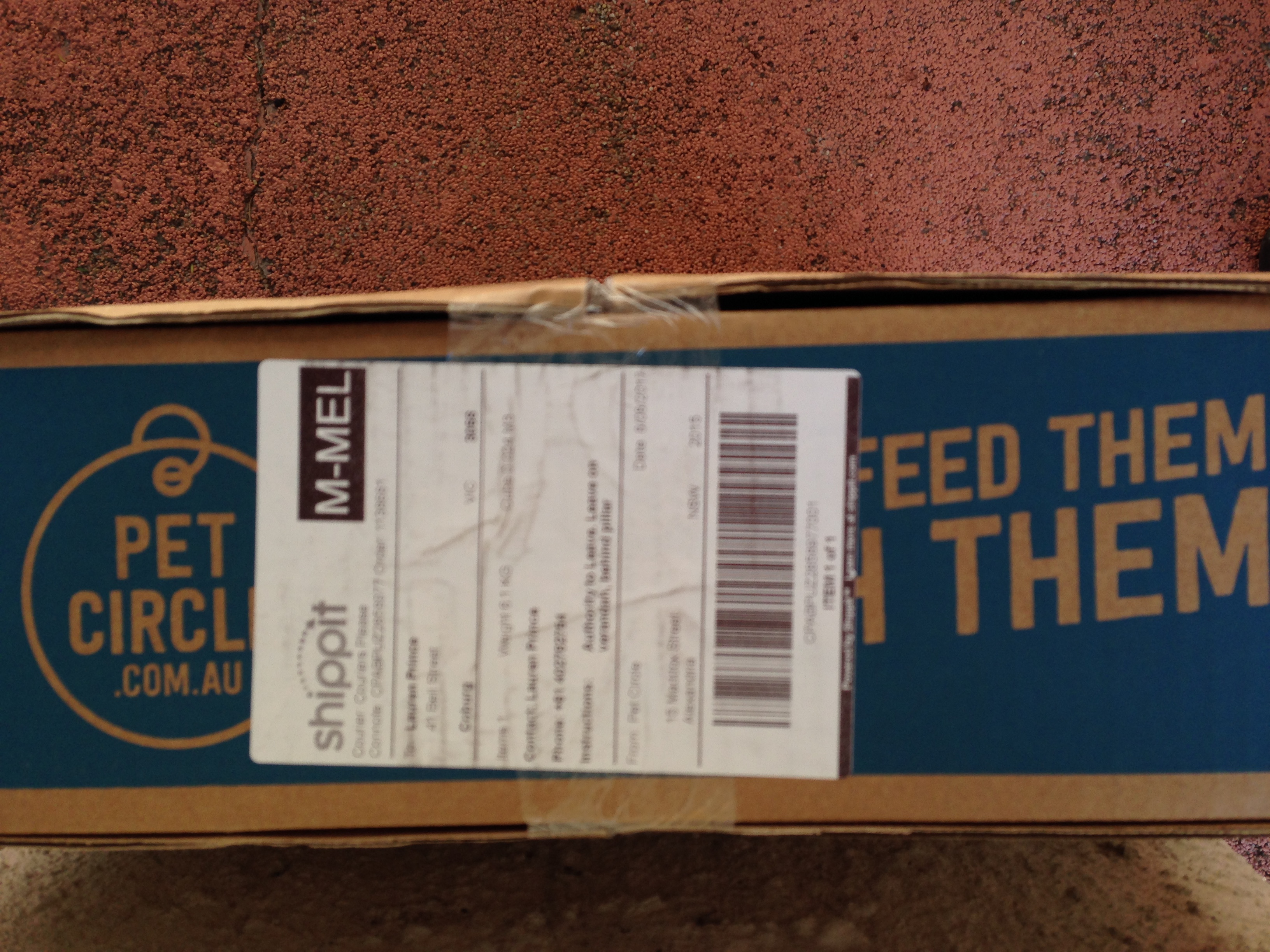
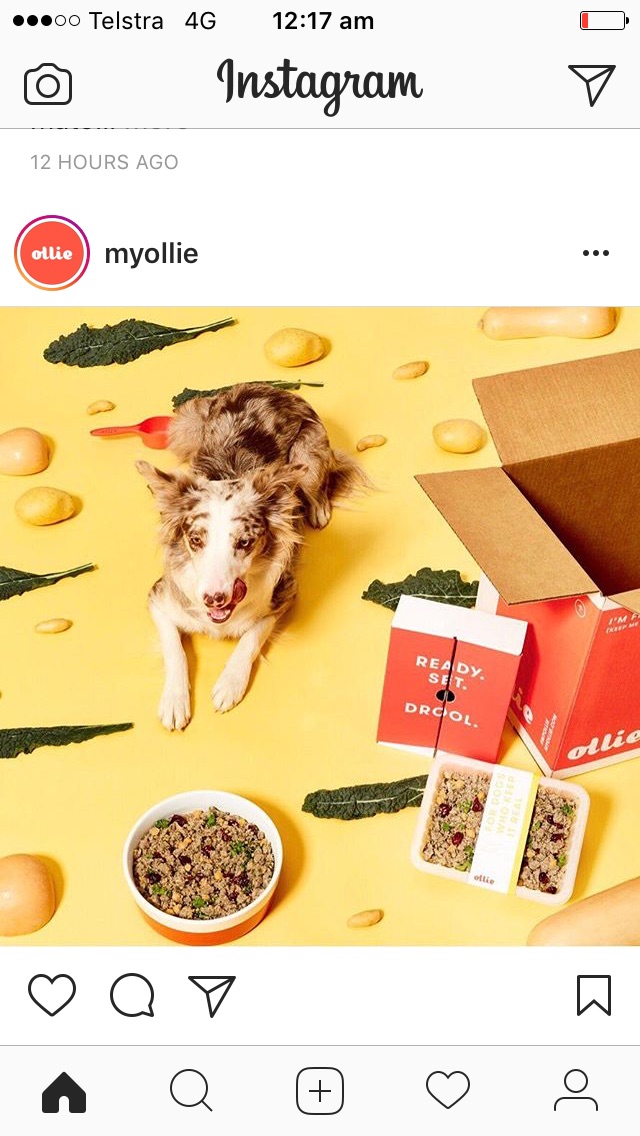
Two flavours of competitor mattered. Local adjacent competitors — Pet Circle being the dominant Australian player at the time — taught me how category shipping, fulfilment partners (their stack ran on Shippit), unit-pricing and cross-sell worked at volume. I ordered from them, inspected their packaging, studied their shipping labels, timed their deliveries, and mapped their logistics network. Overseas reference competitors — Ollie in the US being the clearest analogue — gave me a visual and brand language to react against. I studied Ollie's Instagram cadence, creative direction, tone, and box design to work out where Petzyo should differ (warmer, more Australian, plan-led rather than bag-led), not just where it should copy.

Track 03 · Packaging research

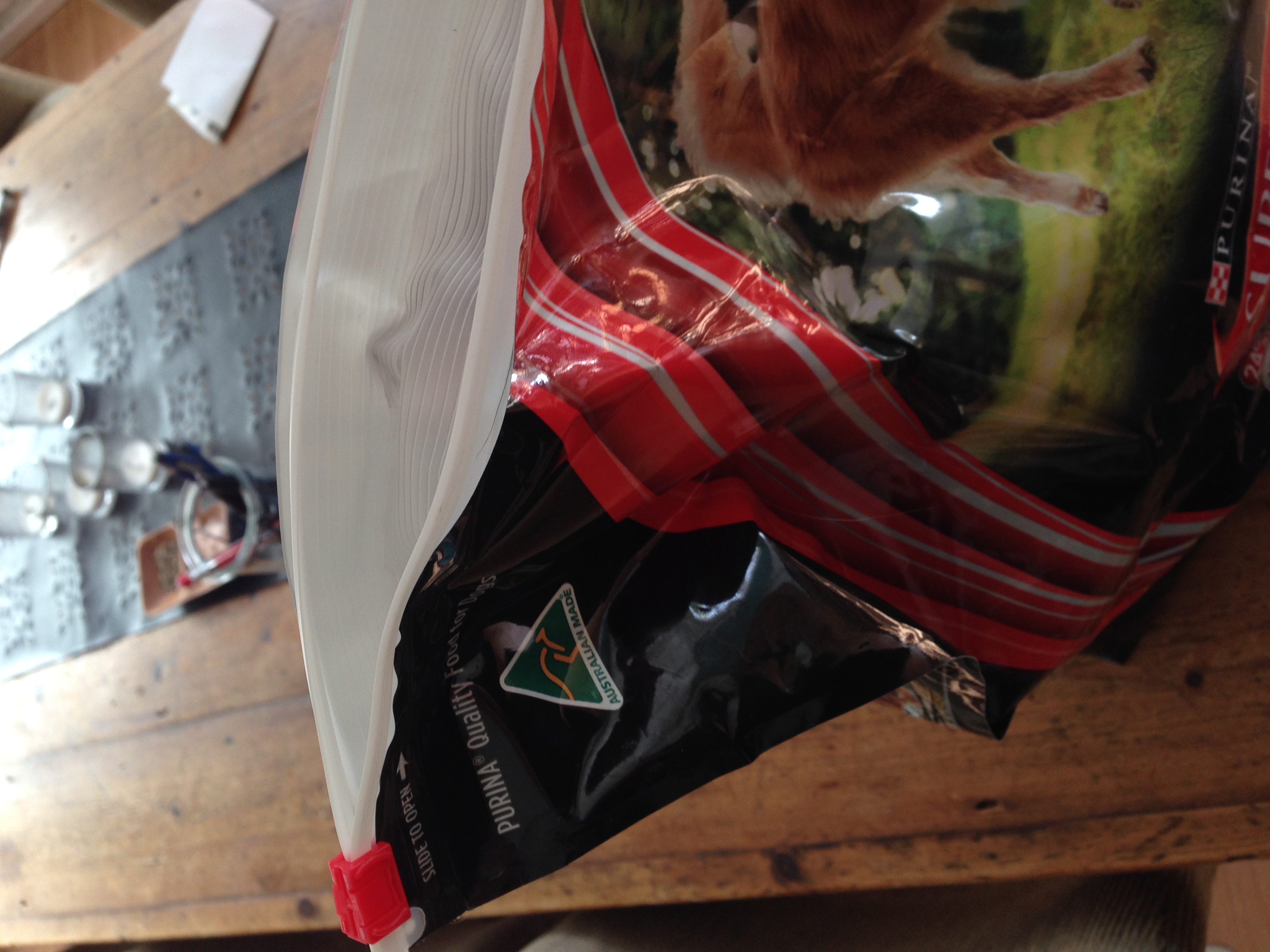
Packaging is where D2C pet food lives or dies — it's the product the customer literally touches. I bought and studied competitor bags across the full spectrum, from supermarket premium (Purina) to specialty and imported brands. The details that mattered: the zip-closure mechanism (resealability drives perceived freshness and premium feel), the Australian Made credential placement and visual weight, barrier-film construction, tear-strip behaviour, portion-measurement cues, and photography conventions. Every bag I opened contributed one small decision to what Petzyo's packaging would eventually do differently.

Track 04 · Production research

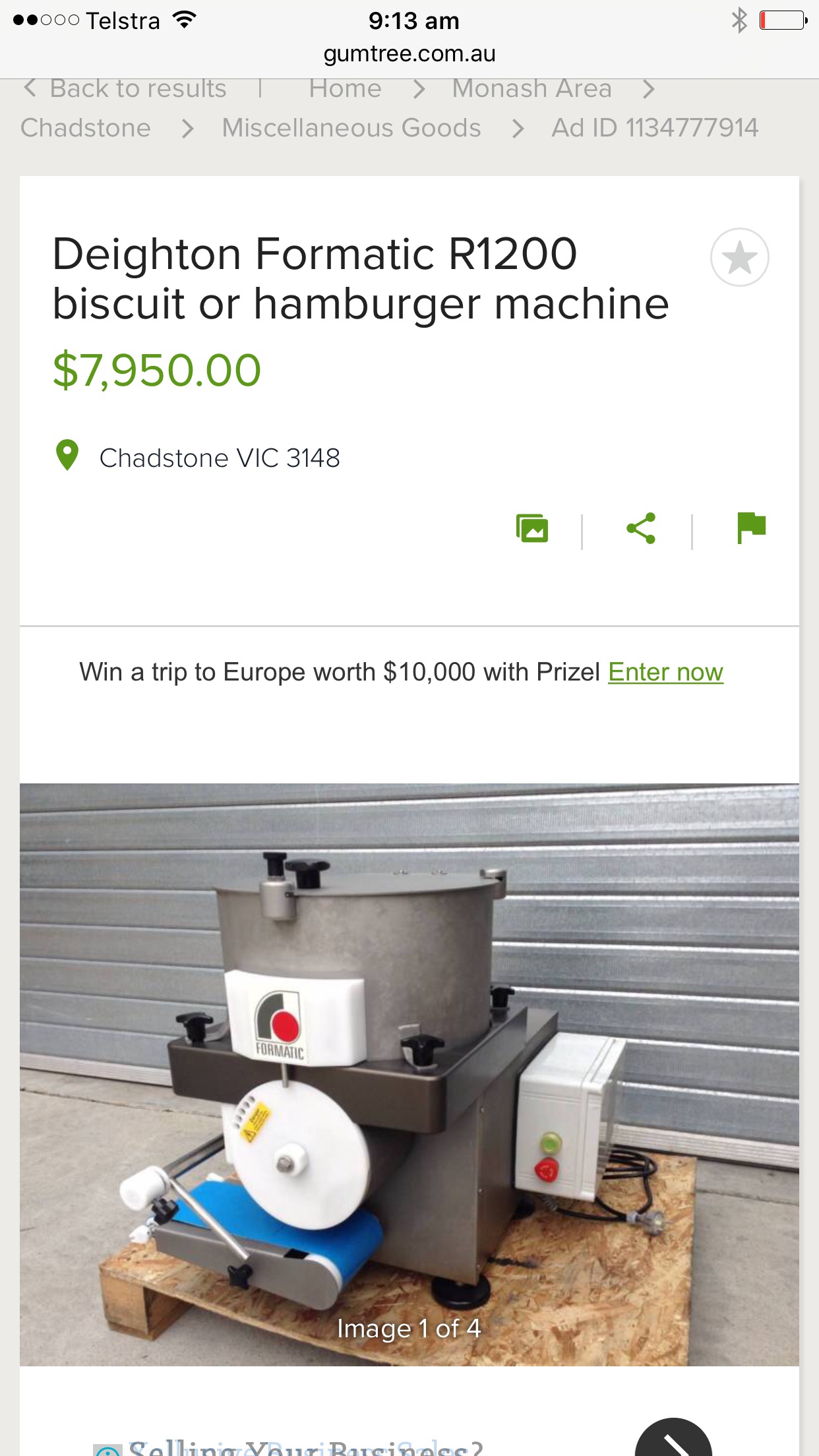
The final track was the one most first-time founders skip: understanding the manufacturing economics before you commit to a partner. I studied both ends — outsourced contract manufacturing with Australian pet-food producers (formulations, MOQs, landed COGS per bag at different volume tiers), and the alternative of bringing a small-run production line in-house. That included researching specific machinery — forming/portioning equipment, ingredient-handling, sealing — and tracking second-hand pricing on platforms like Gumtree so I had a realistic view of what capital outlay in-house production would need. I never bought a machine; but knowing exactly what one cost meant I could negotiate with contract manufacturers from a position of genuine understanding.

The reason four tracks

Any one of these tracks in isolation produces a partial picture. Market alone tells you if people want it. Competitors alone tells you how the game is currently played. Packaging alone tells you how the product is perceived. Production alone tells you whether it can be made at margin. You need all four — and you need them before the business plan, not after — or the plan is built on guesses. I ran them in parallel to compress the learning, not sequentially.

Research gallery — field artefacts

Below are five specific artefacts from this period. Each is a piece of physical or digital evidence from one of the four research tracks. Captions explain what each told me and how that insight eventually shaped Petzyo.

Marley Spoon $35-off mailer card 01 · Market

Marley Spoon mailer — the D2C acquisition playbook Australians were already trained to expect.

Ollie @myollie Instagram — US D2C personalised dog food reference 02 · Competitor (US)

Ollie — the US analogue. Studied to decide where Petzyo should deliberately differ.

Pet Circle shipping box with Shippit M-MEL label 03 · Competitor (AU)

Pet Circle unboxing — the dominant player's shipping experience, mapped end-to-end.

Purina bag zip closure and Australian Made badge 04 · Packaging

Incumbent zip closure + Aus Made badge — what to keep, what to replace, what to invert.

Deighton Formatic R1200 forming machine, $7,950 Gumtree listing 05 · Production

Formatic R1200 on Gumtree, $7,950 — priced vertical integration to negotiate honestly with CMs.

"The point of a prototype isn't to impress investors. It's to give yourself permission to kill the parts that don't work, before they cost real money."
Chapter 04 · Design & productisation

The plan was the product. Everything else was scaffolding.

The single biggest design decision at Petzyo was that the hero of the experience was the plan, not the bag. A new customer didn't see "12 kg Chicken & Rice, $89" — they saw "Biscuit's plan: 2 cups/day, delivered every 28 days, $X/month, easy to change." That framing then forced every other piece of the design.

The onboarding quiz

The quiz collected the minimum information needed to produce a real recommendation — breed, age, weight, activity level, known sensitivities, treats/human-food habits — and it was designed to feel like a conversation, not a form. Length was a tradeoff I revisited repeatedly: shorter meant higher completion; longer meant more accurate plans and better retention. I ran variants and settled on the shortest version that still produced a defensibly accurate portion recommendation.

Subscription & packaging

Each plan produced a cadence and a bag size. Packaging was built around two rules: (1) the dog's name on the bag — trivially cheap to do in digital-first printing, disproportionately emotional, and (2) portion clarity — owners needed to know, at a glance, how much was one day's food. Small decisions, big retention effect.

The tech stack

Shopify as the storefront, a subscription app for plan management, a transactional-email tool for lifecycle flows, an analytics stack for cohort and funnel tracking, and a 3PL for warehousing and dispatch. I didn't write bespoke software — I orchestrated commodity tools and spent my energy on the unique parts: the quiz logic, the plan rules, the brand voice, and the service.

Design principle

Own the orchestration, rent the infrastructure. Shopify, Klaviyo (or the equivalent), ReCharge-style subscriptions, a 3PL — these are tools you rent. The plan logic, the brand voice, the service discipline — that's what you own. This is the same split I run today on AI projects.

ADD TO BOX — the marketplace extension

By mid-2018 the core subscription was working, and the logical next step was to extend the customer relationship without breaking the operating model. The answer was a marketplace — internally codenamed ADD TO BOX — where subscribers could add pet products (treats, toys, dental, accessories) to their next scheduled delivery, shipped with their existing plan, with no extra shipping cost and no minimum-order friction.

It was a deliberate flywheel play: the personalised food plan was the reason to stay; the marketplace was the reason to spend more. Supplier conversations started in the June period, with first supplier orders placed shortly after. Pricing was positioned to beat online alternatives by stripping out shipping friction — a defensible edge because we already owned the delivery cadence.

IP, compliance and credentials

Through this same window the business locked in the defensible pieces:

Chapter 05 · The second business plan

Plan v2: the one that actually ran the business.

Somewhere around month 6 or 7, enough real data had come in that Plan v1 was obsolete. Plan v2 was the working document — the one I was forecasting cash against, hiring advice around, and steering the business by. It was less about growth story and more about operating discipline.

PETZYO
BUSINESS
PLAN v2
Attachment · Operating document

Petzyo Business Plan v2

PDF · 115 pages · August 2018 · Written by Sam Keil · ~18 months post-launch
Open PDF →

Unlike the Dec 2016 IM, this version was written with real trading data in hand — same period as the MD reports in Chapter 07.

What changed between v1 and v2

Three shifts. First: customer cohorts by channel behaved very differently. Paid social delivered volume but lower retention; organic, referral, and email delivered fewer customers but much higher retention. The plan had to be honest about that mix. Second: the plan moved from forecasting revenue to forecasting contribution margin per cohort. That's a more honest number and it is much harder to lie to yourself about. Third: the plan baked in a far less optimistic view of paid acquisition over time — I assumed CAC would get worse as the easiest audiences saturated, and that turned out to be directionally correct.

What stayed the same

The thesis didn't change. Personalisation, subscription, direct relationship — all still intact. What changed was the unit economics and the operating posture around them.

Chapter 06 · Investment & funding

Bootstrapped — not entirely by choice. Petzyo was too early for Australian VC.

The honest version of the funding story is that Petzyo was too early. In 2016–2018, the Australian venture ecosystem was almost entirely focused on software and SaaS — D2C consumer brands were viewed as too inventory-heavy, too margin-compressed, and too unproven locally to justify a cheque. I had real investor conversations (RMIT Activator, Black Sheep Capital, 4Legs, Venture Group — covered in the earlier entries in this chapter); most of them liked the brand and the numbers but said some version of "we don't do D2C" or "come back when the category is proven in Australia".

The category did get proven — just not by me. Lyka launched in 2018 and became the breakout AU D2C dog food brand, raising significant capital once the thesis was visible. Scratch followed. Both came after Petzyo and benefited from the exact market evidence that Petzyo had been asking investors to imagine. The timing was just wrong — we were asking Australian VCs to back D2C before Australian D2C had a successful reference, and most of them weren't willing to be the first cheque into a category they didn't have a mental model for.

So Petzyo ran on personal capital, a small friends-and-family round, an RMIT Activator loan, and — increasingly over time — the revenue it generated itself. It was bootstrapping by necessity dressed up as bootstrapping by strategy.

What the money went to

Early capital paid for the expensive boring parts: initial product inventory (unavoidable minimum orders), packaging, brand, Shopify and app stack, the first wave of paid-social spend, and a small contingency. No payroll. I didn't pay myself for a long stretch.

The investor conversations that were live in 2018

By mid-2018 the business was in active funding conversations across three parallel tracks — each in a different stage, each kept deliberately separate so no single conversation could dictate terms.

RMIT ACTIVATOR

$25K non-recourse loan, 3-year term.

Presented to RMIT Activator in June 2018. Secured a $25K non-recourse innovation loan. Second drawdown of $12,500 received in July. The cleanest capital in the stack — no equity, no personal guarantee, long horizon.

4LEGS

Strategic partnership & investment, in discussion.

By July a strategic partnership & investment opportunity was live with 4Legs — a potential combination of manufacturing agreement + equity investment. The August report outlines two structural options (3rd-party-first vs. manufacturing-agreement-first) and the risk trade-offs each implied for product formulation, timeline and control.

BLACK SHEEP

Early exploratory discussions.

A parallel investor conversation that stayed early-stage through the period — useful leverage in any negotiation, and good market signal on how the category was being valued at the time.

VENTURE GROUP

Capital raising opportunity — on hold.

A traditional VC-style raise was explored and then deliberately paused. The reasoning: raise from a position of strength, not necessity. The August report captured it directly — "Funds required to support growth; marketing costs can be cut until this time."

Why that mix

The portfolio of conversations was deliberate. Non-recourse grant money (RMIT) underwrote the growth experiments. A strategic partner (4Legs) offered manufacturing depth plus capital, but came with product-formulation control trade-offs that needed time to work through. A pure financial investor (Black Sheep) offered optionality without the operational strings. And the VC track (Venture Group) was held until the business could negotiate from strength. Four parallel conversations, one founder, one set of numbers to show them all.

Chapter 07 · Growth, operations & the numbers

30% month-on-month, for four consecutive months. No fluke.

Growth did not come from a single viral moment or a single channel. It came from a consistent cadence of small experiments — creative variants, audience tests, landing-page iterations, price tests, reorder-flow tweaks, email subject lines. I killed what didn't pay back inside two cycles and doubled down on what did. The numbers below are pulled straight from my internal Managing Director reports for April through August 2018 — the reports I wrote for my own board and advisors at the time.

Subscribers
93 → 240
April → August 2018 (5 months)
Peak MoM growth
37.6%
Averaging 30%+ for 4 months
Annualised fwd revenue
$65K → $170K
2.6× in 5 months
Best-ROI month
August
$3.9K ad spend · +56 subs · +30%

The monthly view — Managing Director reports, 2018

Transcribed from the internal reports. Numbers are as-reported at the time.

Metric Apr May Jun Jul Aug
Active subscribers 93 101 139 184 240
MoM subscriber growth +8.6% +37.6% +32.4% +30.4%
Monthly revenue (meal plans) $6,157 $7,945 $9,663 $12,830
Annualised forward revenue ~$65K ~$81K ~$104K $129K $169,932
Accumulated revenue YTD $10,999 $18,112 $29,000 $41,389
Advertising spend ~$3,775 $1,087 $9,600 $5,097 $3,902
What this actually shows

The story isn't just "growth." It's that growth improved as spend dropped. In August 2018, we added more subscribers than in any previous month (+56, hitting 240 active) while ad spend fell to $3,902 — ~40% below July. That's the mar-tech stack starting to pay for itself: lifecycle flows, referral, retention, and organic all doing their share of the work. The August MD report captures it plainly: "Excellent results with low marketing spend ($<4,000 of $6,000). Mar-tech initiative starting to have effect."

The quiet compounders

Three things quietly did an enormous amount of the work. Email lifecycle flows (onboarding, first-reorder, plan-change, re-engagement). Referral — happy pet owners are one of the best word-of-mouth audiences on earth. And service recovery — how a business handles a late delivery or a fussy eater is 10× more durable a brand moment than any ad.

Operational milestones across those five months

The numbers are the headline, but the operating story underneath them matters:

"Growth that needs more money to keep going isn't growth — it's a subsidy. August 2018 was the month the business stopped needing the subsidy."
Chapter 08 · Learnings

What Petzyo taught me — the expensive half and the useful half.

The Petzyo story had two very different kinds of lessons inside it. One set came from building and operating the business day-to-day — product, brand, unit economics, growth — and almost all of those transfer directly to the AI work I do now. The other set came from how the exit went, and those are the lessons I would pay any amount to have learned from reading someone else's case study instead of from living through my own.

I'm leading with the exit lessons because they're the ones I most wish someone had put in front of me in 2016.

Part I · Founder lessons

Paid for in the exit.

These three came out of how the Petzyo exit went. They're the single most important thing on this page if you're a solo founder — not theoretical. I signed an NDA as part of the transaction, so the specifics (counterparty, mechanics, dollar figures) stay off the page; the shape of what I learned does not.

FOUNDER LESSON 01

Trust what people do, not what they say.

The reliable signal is what people do in the 12–24 months after a fundraising or partnership conversation, especially in small conflicts where no one is watching. Don't grant meaningful power in your company on the strength of a first impression.

FOUNDER LESSON 02

Do not sell meaningful equity early.

Equity's control value matters more than its dollar value. A single holder with enough of a stake to exert pressure is a permanent lever someone else can pull. Bootstrap further than feels comfortable; prefer debt, revenue-based financing, or deferred compensation before you sell shares.

FOUNDER LESSON 03

Never let anyone else take custody of your accounts or legal.

"Helpful" offers to manage your books, banking, or paperwork can be generous — and can also be the mechanism by which you get locked out of your own business later. Keep bookkeeper and solicitor in your own name, paid directly, always. Do not centralise those relationships through anyone else.

Part II · Product & operating lessons

The habits that transfer to AI.

People sometimes treat Petzyo as a separate chapter of my career from the AI work I do today. It isn't. The operating habits that made Petzyo work are almost exactly the habits that make AI products work in 2026.

LESSON 01

Personalisation is a pipeline, not a feature.

A "personalised" product is only as good as the signals you collect, the decisions you let the system make, and the fallbacks when it's wrong. Petzyo's plan engine was a much simpler version of what any AI-driven recommendation or agent system has to do today — and the discipline is the same.

LESSON 02

Small experiments compound. Big bets rarely do.

30% MoM came from dozens of small tests, most of which failed. The best AI pilots work the same way — ship small, measure, kill or keep. Resist the pull of the giant transformation project.

LESSON 03

Own the orchestration, rent the infrastructure.

I didn't build a factory; I built a brand and an operating spec. In AI, you usually don't need to own the model, the infra, or the vector store — you need to own the data access rules, the prompts, and the evaluation.

LESSON 04

The quietest moat is how you handle being wrong.

Refunds, replacements, honest conversations — that built the Petzyo brand more than any ad. The AI-era equivalent is how gracefully your system handles hallucination, disagreement, and escalation. Get that right and the rest earns trust.

LESSON 05

Plan v1 is a sales document. Plan v2 is a mirror.

The second plan — the one you write after six months of real data — is the one that runs the business. The same is true of AI roadmaps: the plan you pitch and the plan you ship should diverge, and the divergence is data, not failure.